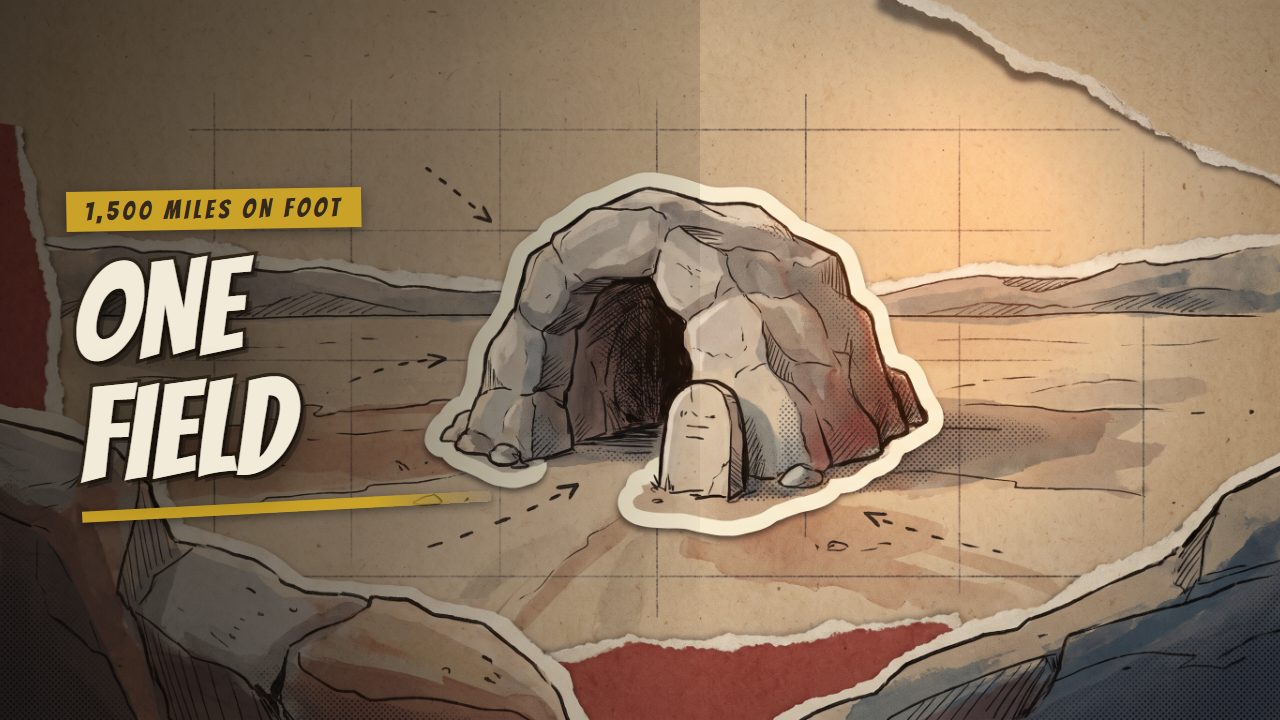
Abraham was promised a whole country. Why did he only buy a grave?
The Story
Abraham is "the man promised the land." Ask what he actually owned there by the time he died, and the honest answer surprises most people.
Fourteen chapters run from the call to the grave. Genesis tells it in order. So do we.
God calls Abram to leave his country, kindred, and father's house, for a land not yet named. He goes, taking Sarai and his nephew Lot.
A famine pushes them into Egypt, where Abram has Sarai pass as his sister; Pharaoh takes her, is struck with plagues, and sends them away.
Back in Canaan, Abram and Lot's flocks outgrow the land, so they part. Lot picks the plain toward Sodom - a city Genesis flags as wicked long before its destruction.
Kings from a regional war take Lot captive; Abram arms his household and rescues him. Melchizedek, a king and priest, blesses him, and God renews His covenant: countless descendants, and affliction in a foreign land before a return.
Still childless, Sarai gives her servant Hagar to Abram, who bears Ishmael. God later renames Abram "Abraham" and Sarai "Sarah," promises them a son, and makes circumcision the covenant's sign.
Three visitors promise a son; Sarah laughs to herself. Abraham negotiates with God over Sodom's fate - but Sodom is destroyed anyway, and Lot's wife, looking back, becomes a pillar of salt.
Abraham repeats the deception with a second king, Abimelech; this time the truth surfaces before harm is done. Sarah bears Isaac, and Hagar and her son are later sent away - but not before God promises her son a nation too.
God tests Abraham, telling him to offer Isaac; an angel stops him, and a ram takes Isaac's place. Sarah dies, and Abraham buys a field and cave to bury her. A servant finds Isaac a wife, Rebekah, and Abraham dies in old age, buried by both sons.
The Call, and Two Cruxes at the Doorway
The call names no destination. God tells Abram to leave his country, kindred, and father's house, for "a land that I will shew thee" - with four promises attached, reaching to "all families of the earth."
"Now the LORD had said unto Abram, Get thee out of thy country, and from thy kindred, and from thy father's house, unto a land that I will shew thee: And I will make of thee a great nation, and I will bless thee, and make thy name great; and thou shalt be a blessing: And I will bless them that bless thee, and curse him that curseth thee: and in thee shall all families of the earth be blessed."GENESIS 12:1–3 · KJV
Genesis dates the departure exactly:
"So Abram departed, as the LORD had spoken unto him; and Lot went with him: and Abram was seventy and five years old when he departed out of Haran."GENESIS 12:4 · KJV
Genesis gives Terah's age as seventy at his sons' births, and his full lifespan as two hundred five. That puts Terah at a hundred forty-five when Abram leaves at seventy-five - sixty years short of his own stated lifespan.
Acts, elsewhere in the same Bible, says Abram left only "when his father was dead":
"Then came he out of the land of the Chaldaeans, and dwelt in Charran: and from thence, when his father was dead, he removed him into this land, wherein ye now dwell."ACTS 7:4 · KJV
One common reading takes Genesis's "seventy" as Terah's age at his firstborn's birth, not Abram's necessarily - a harmonization, not something either verse states.
CAVEATThe math doesn't close on a plain reading of either passage alone. This page doesn't pick a side - it names the numbers and lets you check them.
A second, smaller difference sits at the same doorway. Genesis 12:1 gives the call as "from thy father's house," no place named; Acts 7:2–3 places it earlier - "when he was in Mesopotamia, before he dwelt in Charran."
CAVEATTwo accounts of the same call, worded differently on where and when it happened. Not resolved here.
About 1,500 Miles
The episode's own title number isn't a verse. It's a distance estimate for the whole route - Ur, through Haran, into Canaan, down to Egypt, and back - built from place names in Encyclopaedia Britannica and a straight-line calculation from public map coordinates.
Measured as the crow flies, that route runs about 1,413 miles. Real roads and rivers add distance a straight line can't, so a realistic walking route lands between about 1,550 and 1,625.
"About 1,500 miles" rounds the midpoint of that range to the nearest hundred - one honest way to headline it, not the only one, and not a number Genesis states.
CAVEAT"On foot" is this episode's own title language, not a stated travel mode. Genesis says Abram "departed," "went up," and "journeyed" - never walking versus riding - and later shows the household using camels.
CAVEATThe longest leg, Ur to Haran (about 575 of the 1,500 miles), is Terah leading the family out of Ur (Genesis 11:31) - not Abram's own individually-called journey, anchored at his age-seventy-five departure FROM Haran. The total is his whole recorded travel, not strictly miles walked after the call.
The Rescue, and the Covenant of the Pieces
When Lot is swept up as a captive in a war between rival kings, Abram doesn't hire an army - he arms the men of his own household.
"And when Abram heard that his brother was taken captive, he armed his trained servants, born in his own house, three hundred and eighteen, and pursued them unto Dan."GENESIS 14:14 · KJV
Returning, Melchizedek - a king who is also "the priest of the most high God" - brings out bread and wine and blesses him:
"And Melchizedek king of Salem brought forth bread and wine: and he was the priest of the most high God. And he blessed him, and said, Blessed be Abram of the most high God, possessor of heaven and earth: And blessed be the most high God, which hath delivered thine enemies into thy hand. And he gave him tithes of all."GENESIS 14:18–20 · KJV
Genesis 14:20's own grammar alone doesn't settle who gives the tithe to whom. Hebrews, elsewhere in the same Bible, does:
"To whom also Abraham gave a tenth part of all... Now consider how great this man was, unto whom even the patriarch Abraham gave the tenth of the spoils."HEBREWS 7:2, 7:4 · KJV
God deepens the covenant: an heir "out of thine own bowels," and a seed as numerous as the stars.
"And, behold, the word of the LORD came unto him, saying, This shall not be thine heir; but he that shall come forth out of thine own bowels shall be thine heir. And he brought him forth abroad, and said, Look now toward heaven, and tell the stars, if thou be able to number them: and he said unto him, So shall thy seed be. And he believed in the LORD; and he counted it to him for righteousness."GENESIS 15:4–6 · KJV
In the same speech, God adds a harder promise: affliction in a foreign land, followed by a return.
"And he said unto Abram, Know of a surety that thy seed shall be a stranger in a land that is not theirs, and shall serve them; and they shall afflict them four hundred years; And also that nation, whom they shall serve, will I judge: and afterward shall they come out with great substance... But in the fourth generation they shall come hither again: for the iniquity of the Amorites is not yet full."GENESIS 15:13–14, 15:16 · KJV
One Covenant Speech, Two Honest Tensions
The same speech states "four hundred years" for the affliction, and Acts, elsewhere in the same Bible, repeats that figure. But Exodus, narrating the sojourn itself, gives a different number.
Genesis 15:13 never names a country; Exodus 12:40 names Egypt outright - so it isn't even certain the two verses count the identical span.
CAVEATThis page doesn't assert that four hundred is a rounded four hundred thirty. Both figures, and the scope question underneath them, are named plainly and left open.
A second tension sits two verses later: four hundred years of affliction, returning "in the fourth generation." With the common assumption that a generation runs a few decades, not a century, four hundred years across only four generations reads unusually long.
That assumption about generation length is outside knowledge - the text never defines it, or comments on the gap. We name it; we don't resolve it.
The Bargain for Sodom, and the Field That Remained
Abraham negotiates with God over Sodom's fate, opening at fifty righteous people and naming six numbers across five downward steps: fifty, forty-five, forty, thirty, twenty, ten.
"Peradventure there be fifty righteous within the city: wilt thou also destroy and not spare the place for the fifty righteous that are therein?... And the LORD said, If I find in Sodom fifty righteous within the city, then I will spare all the place for their sakes."GENESIS 18:24, 18:26 · KJV
The text never records him asking below ten - and never gives a death toll or population figure for the city that follows. No number fills that silence.
Sarah dies, and Abraham - calling himself "a stranger and a sojourner" - buys a field, its cave, and its trees, paying four hundred shekels of silver:
"And Abraham hearkened unto Ephron; and Abraham weighed to Ephron the silver, which he had named in the audience of the sons of Heth, four hundred shekels of silver, current money with the merchant."GENESIS 23:16 · KJV
It's the only land Genesis states Abraham purchased outright, despite the land being promised to him again and again. He dies at the story's end, and both sons bury him in that cave:
"And his sons Isaac and Ishmael buried him in the cave of Machpelah, in the field of Ephron the son of Zohar the Hittite, which is before Mamre; The field which Abraham purchased of the sons of Heth: there was Abraham buried, and Sarah his wife."GENESIS 25:9–10 · KJV
Acts, elsewhere in the same Bible, attributes to Abraham a sepulchre purchase "at Sychem," bought "for a sum of money of the sons of Emmor the father of Sychem." Genesis says that exact purchase was "a parcel of a field... at the hand of the children of Hamor, Shechem's father" - his grandson Jacob's, not his own.
CAVEATA genuine KJV-internal cross-book conflation, not this page's invention. The "only land Abraham purchased" claim above is true within Genesis alone; Acts 7:16, read on its own, would say otherwise. Not resolved here.
Keturah, and the Last Honest Tension
Late in life, Abraham takes another wife, Keturah, and has more children by her. Everything he owns goes to Isaac; the other sons are sent east, with gifts, while Abraham is still alive.
"And Abraham gave all that he had unto Isaac. But unto the sons of the concubines, which Abraham had, Abraham gave gifts, and sent them away from Isaac his son, while he yet lived, eastward, unto the east country."GENESIS 25:5–6 · KJV
Genesis calls Keturah "a wife" when introduced (Genesis 25:1), then calls the sons sent east "the sons of the concubines" - without saying whether Keturah's own sons are included in that word.
Chronicles, elsewhere in the same Bible, settles the word outright:
"Now the sons of Keturah, Abraham's concubine: she bare Zimran, and Jokshan..."1 CHRONICLES 1:32 · KJV
CAVEATWife in Genesis, concubine in Chronicles - a real wording difference across two books of the same Bible, on top of a wording gap inside Genesis itself. Not smoothed into a single answer here.
Questions People Ask
How far did Abraham actually travel?
A READINGAbout 1,500 miles is our own honest estimate, not a number Genesis states anywhere. It covers the whole route from Ur through Haran into Canaan, down to Egypt, and back - built from real place identifications (Encyclopaedia Britannica) and a straight-line distance from public map coordinates, then rounded from the midpoint of a wider, realistic range.
Did Abraham really lead a private army?
TEXTNo - the text calls them "trained servants, born in his own house," three hundred and eighteen of them (Genesis 14:14), not an army. They're the men of Abram's own household, armed to rescue his nephew Lot, and the KJV never uses a military word for them.
Who actually gave the tithe to Melchizedek?
TEXTAbraham did - but Genesis 14:20 alone, read strictly by its own pronoun grammar, doesn't settle who gives to whom. Hebrews, elsewhere in the same Bible, states it plainly: "even the patriarch Abraham gave the tenth of the spoils" (Hebrews 7:4).
How old was Abraham when he died?
COMPUTEDA hundred and seventy-five (Genesis 25:7) - the last stop on an age ladder Genesis states in full, five numbers, none invented: seventy-five, eighty-six, ninety-nine, a hundred, a hundred seventy-five.
Was Isaac really Abraham's only son?
A READINGThe KJV's own words are "thine only son Isaac" (Genesis 22:2) - but Ishmael, born years earlier, is still alive at this point. The common reading takes "only son" as "only son by Sarah, the covenant heir," but that qualifier is our own reading, not something Genesis 22 states outright.
Was Keturah Abraham's wife or his concubine?
DISPUTEDBoth words appear in the KJV, and this page doesn't pick one. Genesis calls her "a wife" when she's introduced (Genesis 25:1); Chronicles, elsewhere in the same Bible, calls her "Abraham's concubine" (1 Chronicles 1:32) - a real wording difference across two books, named here, not resolved.
Sources Cited
- Genesis 12:1-4, King James Version: the call, its four promises, and the age at departure - quoted above.
- Genesis 11:26 and 11:32, King James Version: Terah's age at his sons' births and his full lifespan - the numbers behind the Terah chronology crux.
- Acts 7:4, King James Version: "when his father was dead, he removed him" - quoted above.
- Acts 7:2-3, King James Version: "when he was in Mesopotamia, before he dwelt in Charran" - the call-location wording.
- Genesis 14:14 and 14:18-20, King James Version: the 318 trained servants and Melchizedek's blessing - quoted above.
- Hebrews 7:2 and 7:4, King James Version: "Abraham gave the tenth of the spoils" - quoted above.
- Genesis 15:4-6, 15:13-14, and 15:16, King James Version: the stars promise and the covenant's darker promise - quoted above.
- Acts 7:6 and Exodus 12:40, King James Version: "four hundred years" and "four hundred and thirty years" - the years-of-affliction tension.
- Genesis 18:24 and 18:26, King James Version: the Sodom bargain's opening - quoted above; forty-five through ten follow at 18:28-32, not reproduced in full.
- Genesis 23:1, 23:4, and 23:16, King James Version: Sarah's age, Abraham's self-description, and the payment for Machpelah.
- Genesis 25:7-8 and 25:9-10, King James Version: Abraham's death and burial by both sons - quoted above.
- Acts 7:16 and Genesis 33:18-19, King James Version: the Shechem/Machpelah purchase-attribution tension.
- Genesis 25:1 and 25:5-6, King James Version: Keturah introduced as "a wife," and the sons of the concubines sent east.
- 1 Chronicles 1:32, King James Version: "Keturah, Abraham's concubine" - quoted above.
- Encyclopaedia Britannica and public GPS coordinate data: the place identifications and distance calculation behind the "about 1,500 miles" estimate.