Why does the Bible never say the Tower of Babel was destroyed?
The Story
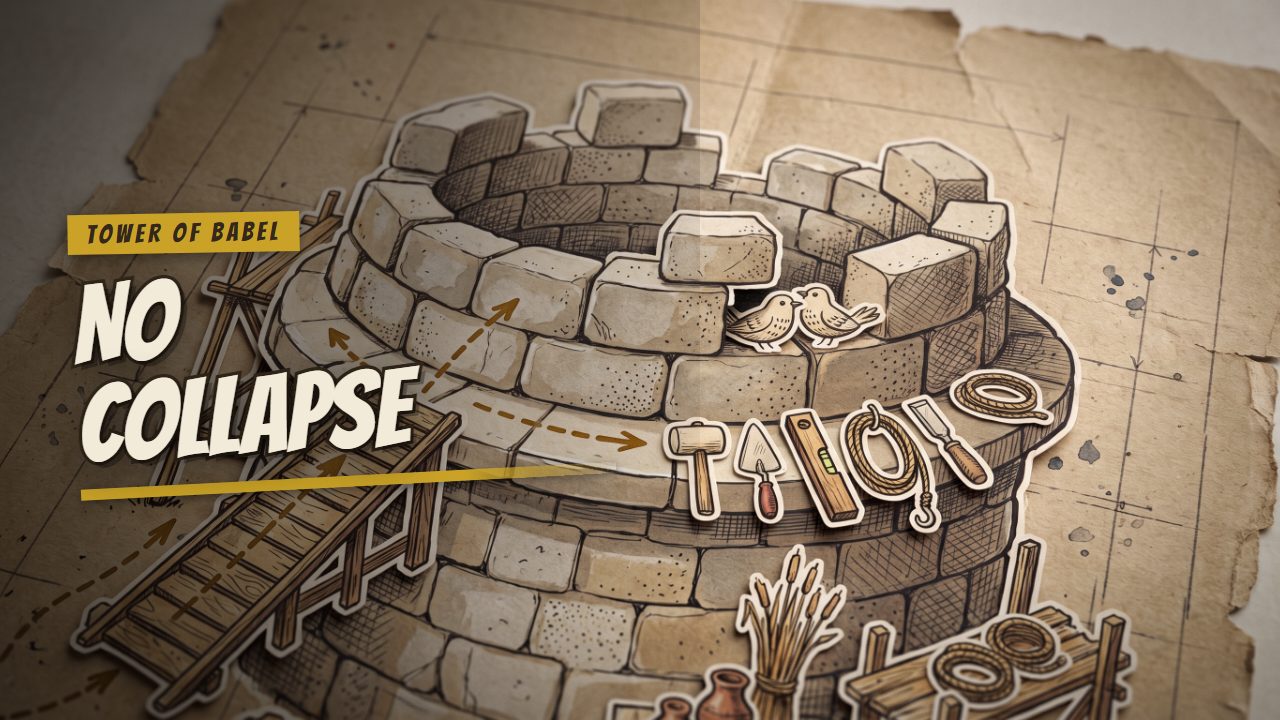
Ask how the Tower of Babel ends and most people say fire, or a storm, or the tower crashing down. Genesis never says that.
It says the builders stopped, and were scattered - the exact thing they built the tower to avoid.
After the flood, Noah's three sons have sons of their own, and the text names them, family line by family line, spreading into nations and languages.
Inside Ham's line, one grandson stands out: Nimrod, called a mighty hunter, whose kingdom begins with cities in the land of Shinar. The text then turns to Shem's own line, reaching a son named Peleg, born "in his days was the earth divided."
Chapter 11 opens with the whole earth speaking one language. People traveling from the east settle on a plain in Shinar, the same place-name from Nimrod's kingdom, and start building: bricks for stone, tar for mortar, a city and a tower "whose top may reach unto heaven."
They state their own reason: to make a name for themselves, so they will not be scattered. The LORD comes down to look, confuses their language, and scatters them; they stop building.
The chapter's back half returns to genealogy, naming the line from Shem down to Terah, each generation recorded the same way. Terah's own household closes the chapter: sons, a grandson named Lot, a wife named Sarai who is barren, a move from Ur toward Canaan that stops short at Haran, and Terah's own death there.
The next verse, in the next chapter, opens with God's call to Abram.
A World Already Sorted by Nation and Tongue
Genesis 10 opens simply: sons are born to Shem, Ham, and Japheth after the flood. What follows is dozens of names, sons, grandsons, and whole peoples, branching across three family lines.
"Now these are the generations of the sons of Noah, Shem, Ham, and Japheth: and unto them were sons born after the flood."GENESIS 10:1 · KJV
The chapter closes the same way it opened - summing up the whole list without ever adding it up.
"These are the families of the sons of Noah, after their generations, in their nations: and by these were the nations divided in the earth after the flood."GENESIS 10:32 · KJV
A long-standing Jewish tradition holds that this table lists exactly seventy nations. That number is not in Genesis 10 itself.
It depends on which entries a counter treats as a separate nation versus a sub-clan - different traditional counts land on seventy, or seventy-two.
CAVEATThe chapter names the world's peoples without ever totaling its own list. Any specific number attached to it comes from outside the text, not from Genesis 10.
All three family lines close with a "tongue" clause - but not identical wording. Japheth's closing says "after his tongue," singular; Ham's and Shem's both say "after their tongues," plural.
Either way, Genesis 10 already talks as if the peoples have their own languages - a full chapter before Genesis 11 opens by taking that apart:
"And the whole earth was of one language, and of one speech."GENESIS 11:1 · KJV
CAVEATThis is an observation about the two chapters' own order, not a contradiction. Genesis 10 reads as a summary sorted by nation and tongue, placed before Genesis 11 narrates the building project and the confusing of language.
Nimrod's Kingdom, Asshur's Cities, and a Real Translation Dispute
Ham's line reaches its biggest name in this chapter: Nimrod, called "a mighty hunter before the LORD." His kingdom begins with four cities in the land of Shinar.
"And Cush begat Nimrod: he began to be a mighty one in the earth. He was a mighty hunter before the LORD: wherefore it is said, Even as Nimrod the mighty hunter before the LORD. And the beginning of his kingdom was Babel, and Erech, and Accad, and Calneh, in the land of Shinar."GENESIS 10:8–10 · KJV
The very next sentence changes subject. Out of that same land, it says, someone else goes and builds four more cities:
"Out of that land went forth Asshur, and builded Nineveh, and the city Rehoboth, and Calah, And Resen between Nineveh and Calah: the same is a great city."GENESIS 10:11–12 · KJV
By the KJV's own grammar, Asshur - not Nimrod - is the one who "went forth" and built Nineveh. Asshur is elsewhere named a son of Shem, a different family line entirely from Nimrod's.
This is a real, live translation question, though. Other mainstream English Bibles, the NIV and NASB among them, render the Hebrew as Nimrod himself going into Assyria to build. This page follows the KJV's own grammar, its only source text, and does not claim that reading is the only one other Bibles give.
One thing does carry forward cleanly: the place-name. "Shinar" names Nimrod's kingdom in this chapter, and the same word names the plain where the tower gets built, one chapter later.
CAVEATGenesis never says Nimrod built the tower himself, or that he was even present for the events of chapter 11 - only the place-name recurs. A Nimrod-built-the-tower story is a popular legend, not something this text states.
The Tower: What the Text Says, and What It Doesn't
The whole earth spoke one language. People traveling from the east settle on a plain in Shinar and state a plan, in their own words:
"And it came to pass, as they journeyed from the east, that they found a plain in the land of Shinar; and they dwelt there. And they said one to another, Go to, let us make brick, and burn them thoroughly. And they had brick for stone, and slime had they for morter. And they said, Go to, let us build us a city and a tower, whose top may reach unto heaven; and let us make us a name, lest we be scattered abroad upon the face of the whole earth."GENESIS 11:2–4 · KJV
The LORD comes down to look. What happens next is stated as directly as the plan was:
"And the LORD came down to see the city and the tower, which the children of men builded. And the LORD said, Behold, the people is one, and they have all one language; and this they begin to do: and now nothing will be restrained from them, which they have imagined to do. Go to, let us go down, and there confound their language, that they may not understand one another's speech. So the LORD scattered them abroad from thence upon the face of all the earth: and they left off to build the city. Therefore is the name of it called Babel; because the LORD did there confound the language of all the earth: and from thence did the LORD scatter them abroad upon the face of all the earth."GENESIS 11:5–9 · KJV
Read the two verses side by side and the irony is exact. The builders name their own fear in one verse; the same words land on them in the passage's climax.
The text also gives its own reason for the city's name, directly: "because the LORD did there confound" (Genesis 11:9). That is a stated cause inside the passage, not an outside guess at wordplay.
CAVEATThe text never states a height, a population, or a duration for the building project - no number is invented for any of these here.
CAVEATNothing in the passage says the tower was destroyed. Its own words are quieter: "they left off to build the city." No storm, no collapse is named anywhere in Genesis 11.
The Real Ruin Nobody Can Measure
In 1913, German archaeologist Robert Koldewey uncovered a massive square foundation, about 91 by 91 meters, in the ruins of Babylon, in the region the Bible itself calls Shinar.
Some scholars propose this ziggurat, Etemenanki, as the real-world structure that may have influenced the Genesis account. Every source treats that link as proposed, never confirmed - "we may never know whether Etemenanki and the Tower of Babel were one and the same," as one Babylonian-studies scholar has put it. Today the site is mostly ruined foundations, about 90 kilometers south of Baghdad, Iraq.
An ancient tablet, a 229 BCE copy known as the Esagila Tablet, claims a height for the tower: 91 meters across seven levels. Modern scholars doubt the figure - a mud-brick tower that tall would struggle to support its own weight.
CAVEATGenesis itself never gives a height at all. Even the doubted number belongs to a separate ancient tablet, found elsewhere - the Bible's own text offers no figure, doubted or otherwise.
Nine Names, Seven Formulas, One Honest Variance
From Shem to Terah, the text names nine people. Seven of them, Arphaxad through Nahor, use the same two-clause wording found in Genesis 5's middle patriarchs: an age at fatherhood, then years lived after.
"And Arphaxad lived five and thirty years, and begat Salah: And Arphaxad lived after he begat Salah four hundred and three years, and begat sons and daughters."GENESIS 11:12–13 · KJV
Shem himself gives the same two numbers a different way, with an extra clause dating it to the flood:
"These are the generations of Shem: Shem was an hundred years old, and begat Arphaxad two years after the flood: And Shem lived after he begat Arphaxad five hundred years, and begat sons and daughters."GENESIS 11:10–11 · KJV
Add each pair of numbers and a real decline shows up, Shem's 600 down to Nahor's 148 - but not on a clean staircase. Eber's 464 rises above Salah's 433, Peleg and Reu tie at 239, and Terah's own 205 rises back above Nahor's 148. Three breaks, not a smooth line.
CAVEATThese totals are our own addition on numbers the text already gives, not a sum Genesis states in one place. Terah is the exception even to that: his total, 205, is given directly and separately, at Genesis 11:32.
Genesis 11:12–13 goes straight from Arphaxad to Salah, with no name between them. Luke's own genealogy, elsewhere in the same Bible, inserts one:
"Which was the son of Saruch, which was the son of Ragau, which was the son of Phalec, which was the son of Heber, which was the son of Sala, Which was the son of Cainan, which was the son of Arphaxad, which was the son of Sem, which was the son of Noe, which was the son of Lamech,"LUKE 3:35–36 · KJV
That extra name, Cainan, comes from the Greek Septuagint tradition Luke's genealogy draws on. The Hebrew-based text behind Genesis 11 does not have him - a genuine manuscript-tradition difference between two KJV passages, shown here plainly, not smoothed over.
Terah's Household, and the Handoff to Abraham
Terah's own household closes the chapter. Three of them carry the rest of Genesis forward: Abram, Lot, and Sarai.
"Now these are the generations of Terah: Terah begat Abram, Nahor, and Haran; and Haran begat Lot. And Haran died before his father Terah in the land of his nativity, in Ur of the Chaldees. And Abram and Nahor took them wives: the name of Abram's wife was Sarai; and the name of Nahor's wife, Milcah, the daughter of Haran, the father of Milcah, and the father of Iscah. But Sarai was barren; she had no child."GENESIS 11:27–30 · KJV
Sarai's barrenness is stated here, plainly, one chapter before it becomes the central tension of the next episode. The family sets out from Ur toward Canaan, and stops at Haran:
"And Terah took Abram his son, and Lot the son of Haran his son's son, and Sarai his daughter in law, his son Abram's wife; and they went forth with them from Ur of the Chaldees, to go into the land of Canaan; and they came unto Haran, and dwelt there. And the days of Terah were two hundred and five years: and Terah died in Haran."GENESIS 11:31–32 · KJV
Terah's own age at death, two hundred and five, is a number the text states directly. The oldest verified living person on Earth today, per Guinness World Records (verified by LongeviQuest), is Ethel Caterham, 116 years old.
Terah's own total is 89 years past that. This is where the episode ends - the very next verse opens the next one: "Now the LORD had said unto Abram, Get thee out of thy country..." (Genesis 12:1).
Questions People Ask
Did God destroy the Tower of Babel?
TEXTNo. Genesis 11 never says the tower was struck down, burned, or collapsed. Its own words are quieter: "they left off to build the city" (Genesis 11:8), because their language had been confounded, not because the structure was destroyed.
Did Nimrod build the Tower of Babel?
TEXTThe text doesn't say. Genesis 11 never names a builder for the tower at all, only "the children of men" (Genesis 11:5); Nimrod's own kingdom, named in the chapter before, never claims the tower itself, and the text never places him at chapter 11's events. A Nimrod-built-the-tower story is a popular legend, not something Genesis states.
Who built Nineveh, Asshur or Nimrod?
DISPUTEDIt depends which Bible you're reading. The KJV's own grammar names Asshur, a son of Shem, as the one who "went forth" and built Nineveh (Genesis 10:11); other mainstream English translations, including the NIV and NASB, render the Hebrew as Nimrod himself doing the building. This page follows the KJV's own reading and does not claim it is the only one.
Does the Bible say there were seventy nations?
A READINGNo, that number comes from tradition, not the text. Genesis 10 names dozens of peoples across three family lines and never totals its own list; a long-standing Jewish tradition puts the count at seventy, or seventy-two depending on the method, but Genesis 10 itself gives no number.
Is there a difference between Genesis and Luke's genealogy here?
DISPUTEDYes, a real one. Genesis 11:12–13 goes straight from Arphaxad to Salah; Luke 3:35–36 inserts an extra generation, a second Cainan, between them, following the Greek Septuagint tradition rather than the Hebrew text behind Genesis 11.
How tall was the Tower of Babel?
TEXTGenesis never gives a number - no height, no population, no duration for the building at all. A separate ancient tablet, not the Bible, claims 91 meters for a related ziggurat, Etemenanki, but modern scholars doubt even that figure.
Sources Cited
- Genesis 10:1, King James Version: "Now these are the generations of the sons of Noah, Shem, Ham, and Japheth: and unto them were sons born after the flood." Genesis 10:32, King James Version: "These are the families of the sons of Noah, after their generations, in their nations: and by these were the nations divided in the earth after the flood." The Table of Nations opens and closes without a total.
- Genesis 10:5, 10:20, and 10:31, King James Version: the three "tongue" closings - Japheth's "after his tongue" (singular), Ham's and Shem's "after their tongues" (plural). Genesis 11:1, King James Version: "And the whole earth was of one language, and of one speech."
- Genesis 10:8–10, King James Version, on Nimrod and the four cities of his kingdom; Genesis 10:11–12, King James Version, on Asshur going forth to build Nineveh - the KJV's own grammar names Asshur, though other mainstream translations (NIV, NASB) render Nimrod as the subject.
- Genesis 11:2–4, King James Version, and Genesis 11:5–9, King James Version: the full Babel passage, quoted above in full.
- Genesis 11:10–32: nine names, Shem to Terah. Adding the two numbers each one gives, the totals fall overall - Shem's 600 down to Nahor's 148 - but not in a straight line: Eber and Terah both rise above the name before them, and Peleg and Reu tie. Terah's own total, two hundred and five (Genesis 11:32: "And the days of Terah were two hundred and five years: and Terah died in Haran."), is stated directly, not our own arithmetic.
- Luke 3:35–36, King James Version, on the "second Cainan" - a manuscript-tradition variance from the Septuagint, absent from the Hebrew-based text behind Genesis 11.
- Genesis 11:27–30, King James Version, on Terah's household - Abram, Nahor, Haran, Lot, and Sarai's barrenness. Genesis 11:31–32 to 12:1: Terah dies in Haran; the very next verse opens the LORD's own call to Abram. That's this episode's own end point.
- Genesis 10 names dozens of peoples across three family lines and never totals them. The traditional "seventy nations" count is a later tradition, not text-stated - we don't use it as a fact.
- Robert Koldewey's 1913 excavation of Etemenanki, Babylon (region: ancient Shinar); the Esagila Tablet's disputed 91-meter height claim; and the proposed-not-confirmed link between Etemenanki and the Genesis account, per National Geographic's reporting citing Andrew George, SOAS. See EXTERNAL_SOURCES.md.
- The Statue of Liberty's height, 93 meters ground to torch (U.S. National Park Service), and the oldest verified living person today, Ethel Caterham, 116 (Guinness World Records, verified by LongeviQuest) - used here purely as scale comparisons, not as claims about the Bible's own numbers.