It rained 40 days. Why was Noah on the ark for over a year?
The Story
You know Noah's Ark as a story: two of every animal, forty days of rain, a rainbow at the end. In Genesis six, the story stops and a blueprint starts - exact numbers for a ship, a family, and a flood.
God saw that the wickedness of man was great in the earth, and the earth was filled with violence. But Noah found grace in the eyes of the LORD - a just man, father of three sons: Shem, Ham, and Japheth.
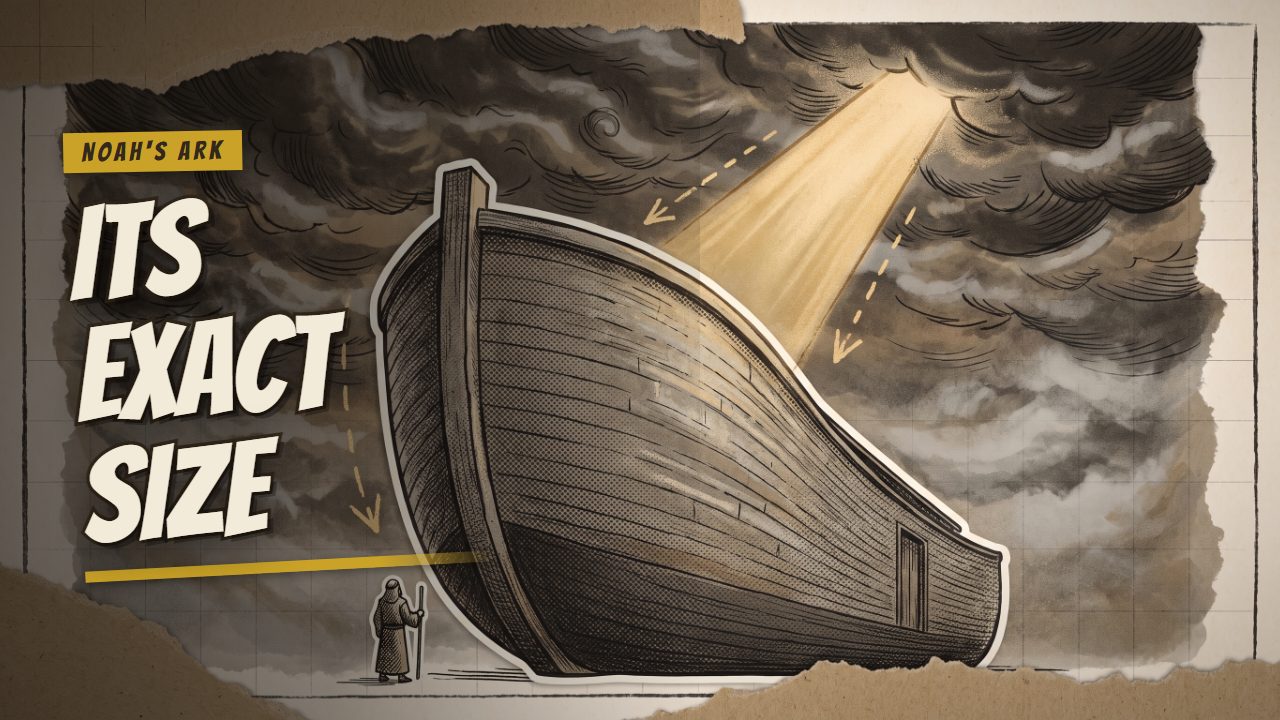
God told Noah to build an ark of gopher wood, with rooms inside, sealed within and without with pitch. The dimensions came next: three hundred cubits long, fifty wide, thirty high - a window, a door in the side, three stories within.
Two of every sort came aboard, male and female; the clean beasts by sevens. Eight people walked in - Noah, his wife, his three sons, and their wives - and the LORD shut him in.
Seven days later the rain began: forty days and forty nights, while the fountains of the great deep broke open. The waters lifted the ark and prevailed on the earth a hundred and fifty days, and the mountains were covered.
Then God remembered Noah and made a wind pass over the earth. The ark rested on the mountains of Ararat; the mountaintops appeared; Noah sent out a raven, then a dove three times, until the ground was dry.
Noah went out, built an altar, and God set a rainbow in the clouds as the sign of a covenant: never again would a flood destroy the earth. Then came a family scene most retellings skip - Noah's own drunkenness, and a curse he spoke on his grandson, not his son.
The Command and the Blueprint
The order itself, in the text's own words:
"Make thee an ark of gopher wood; rooms shalt thou make in the ark, and shalt pitch it within and without with pitch."GENESIS 6:14 · KJV
The rest of the interior Scripture gives is one more verse - a window, a door, three levels:
"A window shalt thou make to the ark, and in a cubit shalt thou finish it above; and the door of the ark shalt thou set in the side thereof; with lower, second, and third stories shalt thou make it."GENESIS 6:16 · KJV
That is nearly every interior detail the text gives. Rooms, decks, a door, a window - the rest of any picture, floor plan, or stall layout is guesswork, not Scripture.
Earlier in the same passage, one number is spoken over all mankind: "his days shall be an hundred and twenty years" (Genesis 6:3).
Tradition reads that as the time God gave Noah to build the ark. But the verse itself never ties the 120 years to the ark - a widely held scholarly reading takes it as a lifespan cap on humanity instead.
CAVEATThe text's interior detail stops at rooms, a door, a window, and three stories (Genesis 6:14, 6:16) - no named rooms, no stall layout, no floor plan. A labeled diagram of the ark's inside is invention carrying the weight of a cited fact.
The Size, By the Numbers
The dimensions, stated outright:
"Length of the ark shall be three hundred cubits, the breadth of it fifty cubits, and the height of it thirty cubits."GENESIS 6:15 · KJV
At roughly eighteen inches to a cubit, that is a ship about four hundred fifty feet long, seventy five wide, forty five high. Ancient cubits varied by era and region - about seventeen and a half to twenty and a half inches - so treat the foot figures as an estimate.
Set on a football field, the hull runs one and a half playing fields nose to tail. Three full decks, at the hull's own footprint, add up to just over two playing fields of floor.
For scale the other way: the RMS Titanic, built thousands of years later, measured 882 feet 9 inches overall - not quite two arks, nose to tail.
CAVEATEvery conversion here rests on an assumed 18-inch cubit and, for the deck total, three full-footprint decks - Genesis 6:16 states three stories, not their individual size. The football field used for scale is a 300-foot field, goal line to goal line; against a full 360-foot field the ratio changes.
Boarding: Two of Every Sort, Eight People
Two rules govern who came aboard, and the text never lets one stand without the other:
"Two of every sort shalt thou bring into the ark."GENESIS 6:19 · KJV
"Of every clean beast thou shalt take to thee by sevens, the male and his female."GENESIS 7:2 · KJV
The people: Noah, his three sons, and their wives - Noah's wife and the three wives named only as "wives," never by name (Genesis 7:13). Then:
"And the LORD shut him in."GENESIS 7:16 · KJV
The New Testament repeats the same headcount in its own words:
"Few, that is, eight souls were saved by water."1 PETER 3:20 · KJV
CAVEAT"By sevens" is the text's own phrase - it is genuinely ambiguous between seven individuals and seven pairs, and this page never resolves it into one counted integer. Genesis 7:9's arrival account also says clean and unclean beasts alike went in "two and two," a known variance not hidden here.
CAVEATGenesis names all four men who boarded. It never names the four women - not Noah's wife, not any of his sons' wives.
Forty Days, One Hundred Fifty Days
The text gives a start date, then the rain that followed it:
"In the six hundredth year of Noah's life, in the second month, the seventeenth day of the month, the same day were all the fountains of the great deep broken up, and the windows of heaven were opened."GENESIS 7:11 · KJV
"And the rain was upon the earth forty days and forty nights."GENESIS 7:12 · KJV
The waters then prevailed on the earth a hundred and fifty days (Genesis 7:24) before they began to abate.
One more measurement, and the only one the text gives for the water itself:
"Fifteen cubits upward did the waters prevail; and the mountains were covered."GENESIS 7:20 · KJV
At an eighteen-inch cubit, fifteen cubits is about twenty two and a half feet - the span the waters rose, in the text's own account.
CAVEAT"Fifteen cubits upward did the waters prevail" states a span, not a depth measured over the mountain peaks. Reading it as "fifteen cubits above the highest peak" is a traditional inference this page does not make - the verse gives the rise, nothing more.
Waters Recede: Ararat and the Doves
God remembered Noah, and made a wind pass over the earth (Genesis 8:1). Then the ark came to rest:
"The ark rested in the seventh month, on the seventeenth day of the month, upon the mountains of Ararat."GENESIS 8:4 · KJV
"Mountains" is plural in the text - a range, not one peak.
Mountaintops appeared on the first day of the tenth month (Genesis 8:5). Then Noah tested the water three times.
First a raven, which "went forth to and fro" (Genesis 8:7). Then a dove:
"The dove found no rest for the sole of her foot."GENESIS 8:8–9 · KJV
Seven days later, the same dove came back with an olive leaf in her mouth (Genesis 8:11). Seven days after that, sent out again, she did not return (Genesis 8:12).
Running the calendar from the door shutting to the earth fully dry: Noah was aboard about one year and ten days. The two dates themselves are the text's own; the span between them is our count.
CAVEATNo single mountain is ever named, and this page names no modern site, on purpose: identifying a specific peak is contested archaeology, not an uncontested fact this series cards.
After the Flood: Covenant and a Family's Fall
Noah's first act on dry land was worship: "Noah builded an altar unto the LORD; and took of every clean beast, and of every clean fowl" (Genesis 8:20). Then came a promise, with a sign:
"I do set my bow in the cloud, and it shall be for a token of a covenant."GENESIS 9:13 · KJV
"Neither shall there any more be a flood to destroy the earth."GENESIS 9:11 · KJV
Noah planted a vineyard, drank its wine, and was found drunk and uncovered in his own tent (Genesis 9:20–21). His son Ham saw him and told his brothers; Shem and Japheth walked in backward and covered their father without looking (Genesis 9:22–23).
When Noah woke, the curse fell on his grandson, not his son:
"Cursed be Canaan; a servant of servants shall he be unto his brethren."GENESIS 9:25 · KJV
"Blessed be the LORD God of Shem; and Canaan shall be his servant."GENESIS 9:26 · KJV
Shem's own line runs on to Abraham (Genesis 11:10–26).
Noah's own life closes with one more number: "all the days of Noah were nine hundred and fifty years: and he died" (Genesis 9:28–29) - three hundred fifty of them after the flood.
Centuries later, in the Gospels, Jesus points back to this same story to describe his own return: "as the days of Noe were, so shall also the coming of the Son of man be" (Matthew 24:37).
A clay tablet in the British Museum, from Nineveh, carries a separate ancient account: a divinely warned man, a great ship, a storm, birds sent out to test the water - the Gilgamesh flood story, Tablet XI.
It is a genuinely documented parallel, credited here as what it is: another ancient account, not a claim about which story came first or whether either depends on the other.
CAVEATGenesis 9:24 records what Ham did; it never says why the curse lands on Canaan specifically rather than Ham himself. This page keeps the text's own wording - "Blessed be the LORD God of Shem," not "blessed Shem" - and leaves the curse's later historical misuse out of scope, a deliberate choice, not a silent skip.
Questions People Ask
How big was Noah's ark, really?
COMPUTEDGenesis 6:15 gives the exact dimensions: three hundred cubits long, fifty wide, thirty high. At roughly eighteen inches to a cubit (ancient cubits varied), that is a ship about four hundred fifty feet long - one and a half football fields, nose to tail, and not quite half the length of the Titanic.
How many people were on Noah's ark?
TEXTEight: Noah, his wife, his three sons, and their three wives (Genesis 7:13) - the text names the men but never the women. The New Testament repeats the same count: "eight souls were saved by water" (1 Peter 3:20).
Did two of every animal board the ark, or seven?
TEXTBoth, for different animals. Genesis 6:19–20 sets the general rule - two of every sort, male and female - and Genesis 7:2–3 refines it for clean beasts: by sevens. "By sevens" is the text's own word; this page never resolves it into one counted number, since it is ambiguous between seven individuals and seven pairs.
How long was Noah on the ark?
COMPUTEDAbout one year and ten days, counting from the door shutting (Genesis 7:11) to the earth being fully dry (Genesis 8:14). Both dates are the text's own; the span between them is this page's own count, not a number Genesis states outright.
Did God curse Ham, or his son Canaan?
TEXTCanaan, not Ham. After Noah wakes from his drunkenness, Genesis 9:25 reads "Cursed be Canaan" - Ham's son, not Ham himself - and the text never states why Canaan specifically bears it.
Sources Cited
- Genesis 6:3, King James Version: "his days shall be an hundred and twenty years." The number itself; the ark build-window reading is tradition, not the verse's own claim.
- Genesis 6:14, King James Version: "Make thee an ark of gopher wood; rooms shalt thou make in the ark, and shalt pitch it within and without with pitch."
- Genesis 6:15, King James Version: "Length of the ark shall be three hundred cubits, the breadth of it fifty cubits, and the height of it thirty cubits."
- Genesis 6:16, King James Version: "A window shalt thou make to the ark, and in a cubit shalt thou finish it above; and the door of the ark shalt thou set in the side thereof; with lower, second, and third stories shalt thou make it." The ark's only other interior detail.
- Genesis 6:19, King James Version: "Two of every sort shalt thou bring into the ark." The general boarding rule.
- Genesis 7:2, King James Version: "Of every clean beast thou shalt take to thee by sevens, the male and his female." The refinement for clean beasts.
- Genesis 7:6, King James Version: "And Noah was six hundred years old when the flood of waters was upon the earth."
- Genesis 7:9, King James Version: the arrival account's own wording, that beasts clean and unclean alike went in "two and two" - the known variance against the by-sevens rule, disclosed above.
- Genesis 7:11, King James Version: the flood's start date and its cause - "the same day were all the fountains of the great deep broken up, and the windows of heaven were opened."
- Genesis 7:12, King James Version: "And the rain was upon the earth forty days and forty nights."
- Genesis 7:13, King James Version: the eight who boarded - Noah, his wife, his three sons, and their three wives, named only as wives.
- Genesis 7:16, King James Version: "And the LORD shut him in."
- Genesis 7:20, King James Version: "Fifteen cubits upward did the waters prevail; and the mountains were covered."
- Genesis 7:24, King James Version: the waters prevailed on the earth a hundred and fifty days.
- Genesis 8:1, 8:4–14, King James Version: God remembering Noah, the ark resting on the mountains of Ararat, and the calendar to the earth's drying - read in full in the episode, not reproduced verse by verse here.
- Genesis 8:7–9, King James Version: the raven and the first dove - "the dove found no rest for the sole of her foot."
- Genesis 8:20, King James Version: "Noah builded an altar unto the LORD; and took of every clean beast, and of every clean fowl."
- Genesis 9:11 and 9:13, King James Version: "Neither shall there any more be a flood to destroy the earth" and "I do set my bow in the cloud, and it shall be for a token of a covenant."
- Genesis 9:20–23, King James Version: Noah's drunkenness and Ham seeing him, read in full in the episode, not reproduced here.
- Genesis 9:25–26, King James Version: "Cursed be Canaan; a servant of servants shall he be unto his brethren" and "Blessed be the LORD God of Shem; and Canaan shall be his servant."
- Genesis 9:28–29, King James Version: "All the days of Noah were nine hundred and fifty years: and he died."
- 1 Peter 3:20, King James Version: "eight souls were saved by water," the New Testament's own count.
- Matthew 24:37, King James Version: "as the days of Noe were, so shall also the coming of the Son of man be."
- The Flood Tablet, British Museum, object K.3375 (Epic of Gilgamesh, Tablet XI, Library of Ashurbanipal, Nineveh, 7th century BC) - a real, documented ancient parallel, credited as itself, not as proof of or derivation from Genesis.